Edward seemed to be continually clambering along rainbows, pursuing fallen stars, suspecting that some monumental wonder was pending, riding on the tide, obscured, perhaps, by a sketch of thin cloud drift. He was the most foolish of the lot, but Ashbless had always liked him. (177)
When I started my research in the fall of 2008, the Wikipedia article on steampunk contained one of the most extensive lists of steampunk reading outside
Steampunkopedia, which I hadn't yet discovered. On that list was a book I remembered from my teens. I remembered it for the insane James (Dinotopia) Gurney cover, featuring a preteen boy wearing a snorkel/scuba mask and riding a cobbled-together digging machine worthy of Looney Tunes's Coyote. I loved the cover, but I was at that point in life where I didn't want to read about kids my age any more. I wanted to read about
real men like Conan the Barbarian and Mack Bolan. I didn't want to wear a scuba mask, I wanted to wear night-vision goggles. I didn't want to drive a digging machine comprised of junk from that shed in the backyard, I wanted to drive Sonny Crockett's Ferrari Daytona. Little did I know that these ideas of manhood were as fake as that Ferrari, but struggling through adolescence, it was easier to deal in hyperbole.
It's likely just as well I
didn't pick up James Blaylock's
The Digging, as its languid pacing, whimsical humour, and lovely prose. I read books at Ferrari-speed in those days: books were the nerd-equivalent of sporting events. How many did you get through in a week? How long were they? How many books had you read in "one night?" None of Blaylock's works can be read in this way. Blaylock is not a Ferrari-speed writer. His prose is too carefully constructed. While he's been accused of being unable to plot a novel (this one in particular, by Lester Del Ray), he certainly knows how to write the moments. My pubescent brain wasn't interested in that pace.
However, my adult brain is interested in such a pace, despite how it frustrates the speed at which I can write about Blayock's books, and by extension, complete my dissertation. Further, at forty, I share a lot more in common with the eccentric weirdos who populate
The Digging Leviathan than I do Robert E. Howard's heroes or Don Pendelton's one-man-army.
Jim spoke of
The Digging Leviathan in an interview with Chris Garcia at the 2010
Nova Albion Steampunk Exhibition. The anecdote is written down in Subterranean Press's
The Man in the Moon: "By the time I was out of college a year I had a hundred thousand words of it, and it was evident that it could never be finished, because the plot funneled outward for the entire length of the book. A few years later a guy in Long Beach (up the coast) tied a bunch of helium balloons to an armchair and flew into the stratosphere (seriously) and the event was so inspirational that it seemed to me to suggest a focus for my long-abandoned book. I launched it again, immediately forgot about the guy with the balloons, and it turned into
The Digging Leviathan." Blaylock also writes of
The Digging Leviathan in "Parenthetically Speaking," the afterword to
The Adventures of Langdon St. Ives. Originall titled
Sanctity of Moontide, Blaylock describes an early draft as "a hybrid of Proust and Laurence Sterne ... set in Glendale and Eagle Rock [involving] Bulgarian acrobats, the mechanical mole, and a dariy that was manufacturing faux milk out of plaster of Paris" (468). This is the madness of Blaylock's writing. While he says that finishing the book required removal of Proust and Sterne, the essential mix of crazed elements remained, though the nature of those elements changed.
Summarizing
The Digging Leviathan is a challenge, due to the crazed nature of those elements. My description is
The 'Burbs meets '60s matinee movies inspired by/based on Verne and Wells. To bring it up to more current terms, imagine a
Desperate Housewives focused on men who are vacillate between obsessing over alternative science, hollow earth theories, and protecting escaped lunatics from the authorities. Jack Horner, in a recent email, asked about Blaylock and "the literary meta-conversation, where concepts and problems from one work are taken, used, and reworked in new works by other authors." Blaylock's work abounds with these elements, all found in
The Digging Leviathan, which acts as a sort of middle-path between Blaylock's steampunk and his urban fantasies such as
All the Bells on Earth and
The Paper Grail.
I noticed the first of these by comparing
The Digging Leviathan,
All the Bells on Earth, and
Homunculus, : the idea of neighborhood, or tight community. It's tough to find a lone wolf like Conan or Mack Bolan in Blaylock. I haven't read everything he's written yet, but there aren't any hyperbolized alpha males with an abundance of testosterone in Blaylock's work, unless it's as a caricature or villain. Blaylock seems to prefer small fraternities of companions who work together to achieve a common goal. In
The Digging Leviathan, it's The Newtonian Society. In
Homunculus it's the Trismegistus Club. In
Bells, it's suburbanite Walt Stebbins, his wife's get-rich-quick-scheming uncle, and a crusading clergyman. In all cases, none of these cadres are made up of the team you imagine following Doc Savage around. There isn't a Monk or Ham in sight, though the dialogue is banter-reminscent. They are bumblers in their efforts at heroism, as attested by a spying-excursion gone wrong in Chapter 14: an attempt at getting a better look through a basement window results in physical comedy, and a hasty retreat to one of the home of one of the Newtonian Society. It's not the humor of Terry Pratchett or Douglas Adams: it's like
Twin Peaks starring Buster Keaton and Charlie Chaplin. Blaylock's heroes are everymen, every last one of them, and they are bound together by often domestic relationships, be that blood-ties or fence-posts.
The second is a cast-intertextuality between
Digging Leviathan and the St. Ives' cycle of stories. In addition to Landon St. Ives' descendant, Edward St. Ives, William Ashbless makes an actual appearance (William Ashbless was the pen name Blaylock and Tim Powers wrote poetry under in University. Ashbless often makes cameos in their work). The villain, Hilario Frosticos, is a descendant of Ignacio Narbondo, villain from the St. Ives story, and the secret of extending life is once again related to fish, as is the case in
Homunculus.
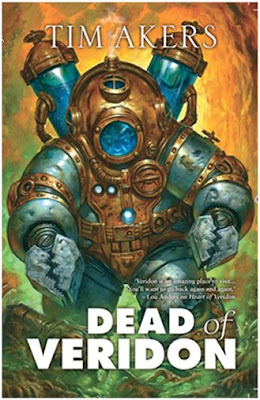
The newer, less evocative cover.
Trying to draw strong correlations between the St. Ives series and
Digging Leviathan seems wrong-headed. Blaylock told me at
Steamcon 2010 that he didn't really think things through that extensively. It's not that the work is haphazard, but rather that he never intended to make a series out them. The names just keep popping up, in a playful manner. There are certainly correspondences, but they are loose ones.
Besides, as
The Digging Leviathan isn't steampunk per se, I'm not overly interested in submitting it to heavy criticism.
The Digging Leviathan is like a love letter to childhood spent with the imagination wide open, but written from an adult's perspective. There are moments focalized by both youthful and mature characters alike, with a sense of romantic visions of "yesteryear," that time before our rational minds murdered childhood fantasies and consigned Pelludicar to impossibility.
When I first read
The Digging Leviathan, it made me think of several friends from
Legion Fantastique, people with a huge interest in old books and rainbows, fallen stars, and monumental wonder. It made me think of many people I've met at steampunk conventions, for whom the punk means little, if nothing at all. For them, steampunk is a space of wonder, an escape from plots and cover illustrations that smack of authenticity.
A few other quotations regarding the gadgetry of
The Digging Leviathan, which caused me to keep imagining steampunk maker Jake von Slatt as one of the characters in
The Digging Leviathan:
The two had pieced together a wonderful gadget around an old fan motor. The machine hadn't any purpose, really, beyond gadgetry. (11)
"All in all it was a sort of art deco wonder of crenelations and fins and thick ripply glass, as if it had been designed by a pulp magazine artists years before the dawn of the space age which would iron flat the wrinkles of imagination and wonder." (13)
"The diving bell itself, borrowed by Professor Latzarel from the Gaviota Oceanographic Laboratory, was round as a ball. It was almost an antique. Hoses led away out of it into great coils, and in a ring around the bell, within the upper one third or so, were a line of portholes riveted shut. There was a hatch at the top, screwed down with what looked like an immense brass valve. The whole thing was etched with corrosion and flaked with blue-green verdigris. It looked to Jim like something out of Jules Verne." (55)
Hence my suggestion that Blaylock be adopted as the patron saint of steampunk, or whatever title we'd like to give him. He's the only one of the original three from California to openly admit writing steampunk to a steampunk crowd. Powers is dubious, and Jeter ain't saying--yet. Further, in addition to his
Langdon St. Ives series, steampunks have been given a book that seems at points, to be the closest anyone has come to writing a novel about the sort of people who are into steampunk. As I've already said - in my head, it's Jake von Slatt and members of Legion Fantastique running around trying to find a kidnapped boy and solve the mystery of the fantastic events and machines that keep popping up around him. The book is filled with passages, too many to include here, that seem to point toward how steampunk plays with the indeterminacy of meaning, the difficulty of knowing history with absolute certainty, and the way in which fiction plays a positive role in a world that prizes scientific rationality so highly.
"To learn the truth was to make things fall apart. Knowledge wasn't a cement, a wall of order against chaos; it was an infinitude of little cracks, running out in a thousand directions, threatening to crumble into fragments our firmest convictions. He couldn't fathom it." (96)
There has been a certain serendipity to the timing of this post. My son recently watched an episode of
The Backyardigans titled "
To the Center of the Earth." He asked how it was that the Backyardigan characters could tunnel deep down beneath the surface of the earth. I replied that they couldn't - they were simply imagining it - whatever the characters imagine seems to actually be happening (an intertextual link to the plot of
Digging Leviathan, by the way, and not simply a cute anecdote). "But maybe someone could make a machine that could do that," he replied. My first inclination was to say, "No, that's impossible," but I stopped myself, and simply replied, "yes, someone might."
"Maybe me," he said.
I smiled. I thought of how I'd watched Doug MacClure in
At the Earth's Core and
Warlords of Atlantis at the Saturday matinee as a kid. How I'd sat on my front porch, designing a bathysphere to take to the Okanagan valley that summer, to search for BC's Nessie, Ogopogo. The world was filled with wonder in those days: no one had stolen it from me yet. I wasn't about to steal it from my son either.
"Maybe you," I told him.
If any of this has stirred up a nostalgia for the days when you still thought you could dig to the center of the earth in a tank with a drill on the front, then you ought to order yourself a used copy of
The Digging Leviathan. I got mine in a used bookstore, and it's pretty dog-eared, but at least it's the cover I remember from my childhood, the one that takes me back in time, like the books in Edward St. Ives' library.
Edward St. Ives was a collector of books, especially of fantasy and science fiction, the older and tawdrier the better. Plots and cover illustrations that smacked of authenticity didn't interest him. It was sea monsters; cigar shaped, crenelated rockets; and unmistakable flying saucers that attracted him. There was something in the appearance of such things that appealed to that part of him that appreciated the old Hudson Wasp. (9)
An unused image by James Gurney for the cover of The Digging Leviathan
. I love this one, since it has that father/son dynamic the book explores.